by John Bechtel | Sep 9, 2016 | Argentina, Buenos Aires, San Telmo
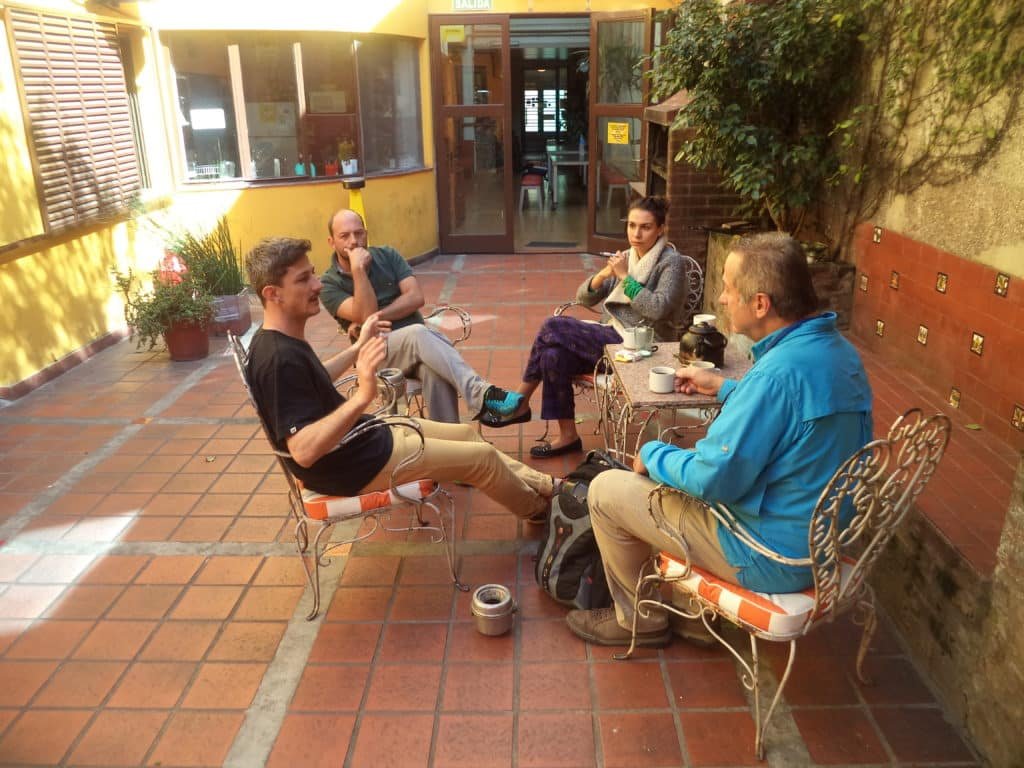
Hostel life can be a germination plateau for new ideas and directions.
A client of mine once said some people live their lives as if they were looking for a lost ball in tall grass. Watching people come and go at Puerto Limon Hostel in San Telmo barrio of Buenos Aires, Argentina over the course of the last month, I am inclined to agree. For those of you who are new to this conversation, I am a freelance writer who has come to Argentina to observe and write, first here in Buenos Aires, and eventually throughout South America. What is this continent all about? How does the Latin history, experience, and culture impact their thinking and choices? Argentina is a country built on immigrants, and they keep on coming. So let’s look at the diverse residents of Puerto Limon as a microcosm of Argentina itself.
I am going to divide the residents into two groups: those who live their life with purpose and those who do not. They can be millenials traveling on their parents money with $10,000 or more invested in their backpacks, cameras, and other totes. Or they can be surviving by working in the hostel for partial room and board. They may sport a PhD, or never graduated from high school. They can have an entry-level go-nowhere job or they can be experienced professionals who have been floored by one of life’s hard knocks, and deciding whether to get up or give up. Whatever their circumstances, all have a choice whether to focus or not, to act or not, to assume responsibility for the direction of their life or to wait for life to happen to them.
(more…)
by John Bechtel | Sep 3, 2016 | Argentina, Buenos Aires, San Telmo, South America

Talented Jorgia from Bahia, Brazil misses the action-orientation and passion of her home country.
One of the things I am enjoying about hostel life is that this place is a beehive of cross-pollination. What is heard here is unfiltered by teams of experts who determine what the public should or shouldn’t hear, or the politically correct interpretation that should be given to events or ideas under discussion. In a month’s time I have lost count of how many countries have been represented here, but I suspect it is close to two dozen or more. I am sometimes amused (and alternatively annoyed) when someone asks what are Argentines like, or what do they think of Americans, as if there is an Argentine mind or an American character. It is a common enough practice, but the following are excerpts from very individual (and sharp) minds culled from the noisy life of Puerto Limon hostel in San Telmo barrio of Buenos Aires. And they have opinions and experiences you may not have heard on CNN.
Are Argentines Passive?
Take Jorgia, for example, a former staffer pictured here, who went on to a teaching job somewhere. Jorgia is from Bahia, Brazil and when she completes her education here she intends to return to Brazil. Her mother tongue is Portuguese, but she also speaks Spanish and impeccably fluent English. She was a quick student as a child and she has adapted well here from all appearances. Jorgia says she gets a little homesick and she doesn’t like certain behaviors she considers common among Argentines. She feels they are too passive and gave as an example when riding on a city bus if the driver fails to stop at a scheduled location, indifferent to the people who have been standing patiently in line for the bus to stop, Jorgia says the people on the bus will say nothing, while back in her Brazilian community everyone on the bus would be yelling at the bus driver to stop; hey, didn’t you see the line back there?! The passengers wouldn’t let the bus driver get away with skipping a stop.
(more…)
by John Bechtel | Sep 3, 2016 | Argentina, Buenos Aires, San Telmo

Are any of these people professional pickpockets?
I had heard about the legendary pickpockets of Buenos Aires before I even left Florida. Supposedly they are some of the most skilled in the world, and indeed I was told they even held conventions and trade shows in Buenos Aires for their craft where they display and share the latest and best techniques for lifting purses and snatching cameras.On my third day I took a walking tour of San Telmo, and as I whipped out my $85.00 Blue-Light KMart Special camera to snap a shot, the guide quietly cautioned me to wrap my hand through the camera strap if I wanted to keep it. He said the pickpockets were known to drive by and snatch cameras loosely held right from your hand and drive quickly on.
Arlean, a 78-year-old expat, and the first I met on arrival in Buenos Aires, told me how she had her wallet and passport lifted from her purse on the subway shortly after her arrival, and it had cost her $100 to get her passport replaced. I was regaled with the story of how on the sidewalks one will come up behind you and drop bird poop on you and another accomplice will rush up to help you clean it up, while the first one beats a hasty retreat in the ensuing confusion–with your wallet in hand. I was told they often work in pairs and one will distract you, perhaps bumping into you on a crowded subway while another makes their move. Any purse, camera, or other valuable not firmly grasped by both hands, or with your arm firmly looped through the shoulder strap is at risk.
Determined not to be a victim to such predators, I quickly made an executive decision to leave my good Canon in its new case locked up in the hostel locker. If they were going to get my camera, they weren’t going to get my good one. I practiced holding my backpack on my back and then on the front of me, clutching it with both hands, with my arms crisscrossed over it in front of me. I watched other subway travelers and studied how they held their purses and bags and even cell phones. I had been told that electronic gadgetry fetched high prices on the street in Argentina and I fully expected to see pickpockets patrolling every subway car looking for careless passengers holding their smart phones loosely by open subway doors, making themselves targets for a grab-and-run.
I began to wonder what a typical pickpocket would look like? Would he be short, small, quick and nimble on his feet? And speaking of feet, I wondered what kind of sneakers he would wear. Would they be shabby, and his clothes likewise labeling him as part of Argentina’s underclass? Or would the really successful pickpockets be dressed to the nines, wearing designer jeans making a pointed statement about their many successes?
(more…)
by John Bechtel | Aug 23, 2016 | Argentina, Buenos Aires, San Telmo, Uncategorized
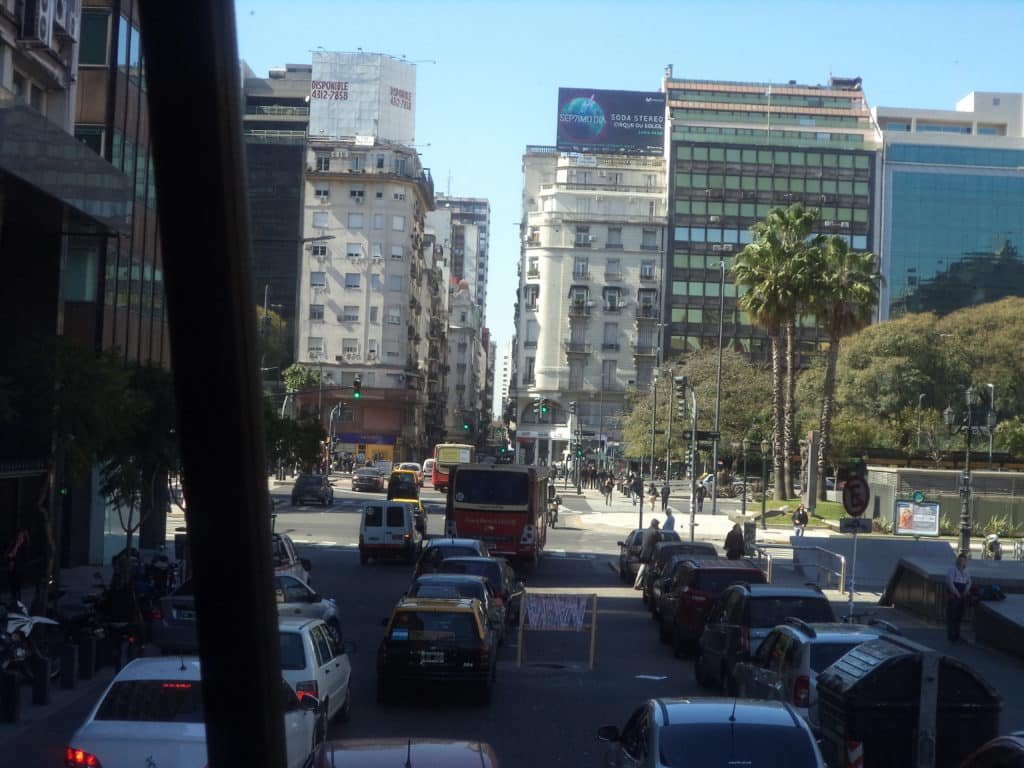
As with any big city, it is the people on the street that you meet that determine the quality of your experience. Hostel Puerto Limon makes you want to stay or come back to Buenos Aires again and again.
On the way to the Tampa airport I felt some vague discomfort in my right hip that grew progressively worse. I was traveling light, with only a backpack and camera case and nothing to check through. However by the time I hobbled from the parking lot to the ticket counter to check in, I knew I was in trouble. I struck up a conversation with an American Airlines staffer who had sensed that I was in pain, and told him it had just happened and I didn’t know what it was about, but I would need help to get through security. He got me a wheelchair and asked if I wanted him to call an ambulance, and I said no, I was going to Buenos Aires.
Only later did I realize what a golden opportunity was given me to turn back at the last minute and how different my life might have become. Sometimes life comes down to just a few moments, and this was perhaps one of them. Did I experience a moment of doubt? More than a few of them. I knew of course that many people younger than me had already replaced major joints such as knees and hips, and perhaps my time had come. How did a bad joint announce itself anyway? Like this, on the way to some airport? And if this is what was happening, what was I going to do once I got to Buenos Aires? Turn right around and come back for a hip replacement operation? And if I did that, what would the chances be that I would ever resume my path of expatriation and extended travel? Was I an absurdity, attempting such foolishness, and had I just been given a sure sign that I should give the whole thing up? Yes, I wondered, but not for too long. I was going to Buenos Aires and we would let the chips fall where they may.
(more…)
by John Bechtel | Aug 19, 2016 | Argentina, Extended travel, South America
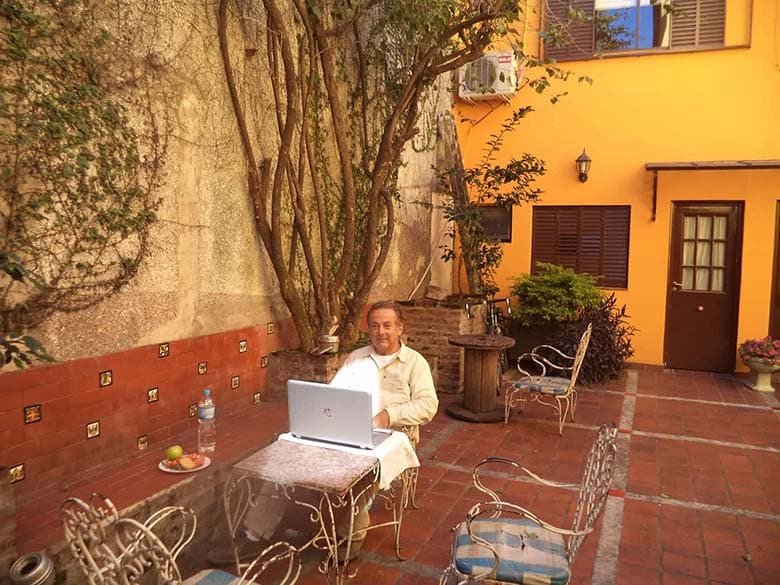
I am a 67-year-old retired businessman who has been an accidental writer all his life, and who now devotes his swan-song years to freelance travel, food, wine and cultural writing. Recently I liquidated all of my belongings except my beloved books, downsized to a backpack, and bought a plane ticket to Buenos Aires, with a two-night reservation at a hostel recommended to me by my vagabonding daughter Allison, who stayed here last year. In my first week I applied for permanent residency to be followed by dual citizenship. I write these words on my laptop from its makeshift perch atop a decaying wooden speaker that is the perfect desktop height as I sit hunched forward in the worn and tattered vinyl overstuffed chair that is ridiculously comfortable—all this in the community room of Puerto Limon where life is just beginning to stir at 7:30 a.m. Argentina time. I am preparing for months of extended travel throughout Argentina and other parts of South America, to be closely followed next summer by more of the same in the Far North of the Arctic region. I chose the hostel method of accommodation because it fosters interaction with other guests from all parts of the world; it puts me close to where I will learn the most. I seek far more than the tourist experience.
What will you do about healthcare?
In the process of getting here, some difficult questions needed to be asked and answered. At my age of course, one of the first such questions is what will I do about health care? Coming from a North American culture obsessed with longevity and denial of the inevitable, this is, or should be, of paramount importance. What will be the quality of health care in a third world nation, what will it cost without the infrastructure and safety nets provided by the world’s most recent empire? My recent health care experiences in Port Richey, FL however, were a revelation.
(more…)




Recent Comments