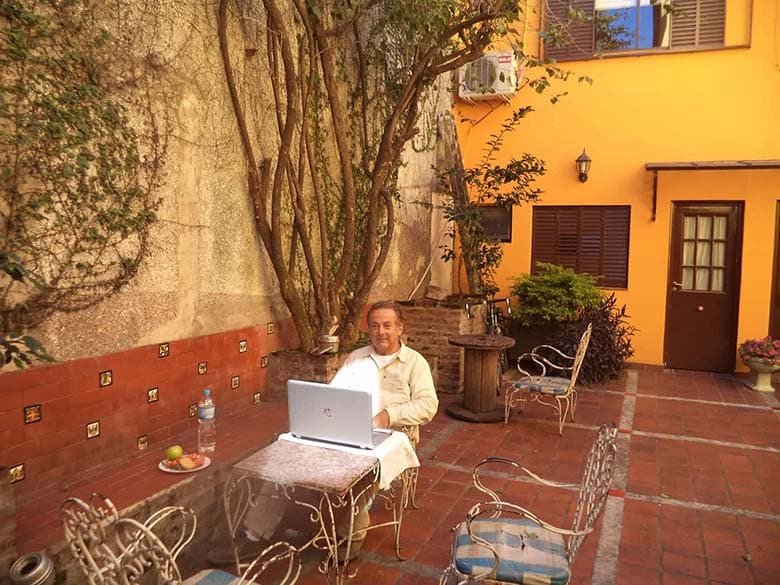
I am a 67-year-old retired businessman who has been an accidental writer all his life, and who now devotes his swan-song years to freelance travel, food, wine and cultural writing. Recently I liquidated all of my belongings except my beloved books, downsized to a backpack, and bought a plane ticket to Buenos Aires, with a two-night reservation at a hostel recommended to me by my vagabonding daughter Allison, who stayed here last year. In my first week I applied for permanent residency to be followed by dual citizenship. I write these words on my laptop from its makeshift perch atop a decaying wooden speaker that is the perfect desktop height as I sit hunched forward in the worn and tattered vinyl overstuffed chair that is ridiculously comfortable—all this in the community room of Puerto Limon where life is just beginning to stir at 7:30 a.m. Argentina time. I am preparing for months of extended travel throughout Argentina and other parts of South America, to be closely followed next summer by more of the same in the Far North of the Arctic region. I chose the hostel method of accommodation because it fosters interaction with other guests from all parts of the world; it puts me close to where I will learn the most. I seek far more than the tourist experience.
What will you do about healthcare?
In the process of getting here, some difficult questions needed to be asked and answered. At my age of course, one of the first such questions is what will I do about health care? Coming from a North American culture obsessed with longevity and denial of the inevitable, this is, or should be, of paramount importance. What will be the quality of health care in a third world nation, what will it cost without the infrastructure and safety nets provided by the world’s most recent empire? My recent health care experiences in Port Richey, FL however, were a revelation.
I have been an accidental writer all my life, and I have been a traveler all my life, but I had never put the two together in a professional way until September 2014 when I attended the Ultimate Travel Writer’s Workshop in San Diego. The three-day event was sponsored and managed by Lori Allen and her team at Great Escape Publishing. The program was written by world adventurer, master copywriter, and Executive Editor of International Living magazine, Jennifer Stevens.
To a certain extent we are all defined by our fears, and my first fear attending this event was that I was going to be the oldest person in the room, surrounded by twenty-something millennials, all exuding boundless energy (and maybe hormones), in love with writing and willing to work for free in order to be called a writer. Maybe they would sneak glances at me and wonder what such a relic was doing there. You know, the way my grown kids look at me.
A Barnes and Noble media event with Kimberly Enlow. My neighbor and friend Kimberly Enlow is Community Business Development Manager at the local Barnes and Noble book store. So when she inquired if I would be interested in participating in a special event at the store, I didn’t think much about it. The event was a day-long public reading of Harper Lee’s classic novel To Kill a Mockingbird. Kimberly was endeavoring to recruit enough readers to read the 375-page book from start to finish in one long day; in my opinion an ambitious goal indeed. A wonderful novel, but it had been almost half a century since I had read it last.
There was a stalwart young lady named Katy on reading duty to an empty row of chairs for listeners when I arrived. As a show of support I sat down and listened, and in a few minutes picked up where Katy was at in the thread of the story. Kim showed up with a smile and a cup of B&N java. When it was time, I began my stint at the reading. I had heard of such readings happening in literary circles and book stores, but I had never participated. It had been years since I had done any reading to an audience, and that had been at a writing club where we each read portions of our own material for critique by other participants. I was not prepared for what happened next.
As I began reading, I quickly got caught up in the material and the events, and almost subliminally became aware of the skill of Harper Lee, who in 1960 managed to deliver social commentary, not as a dry polemic or as editorial lecture thinly disguised as broadcast news, as is so much in vogue today. Harper Lee didn’t preach or scold, but through the skilled use of narrative and dialogue of fictitious characters who came alive on the pages, she transported us to another time and another place to fully experience the pathos and humanity of the prejudices, loves, loyalties, and hatreds that can be found at any time and in any place. She opened our eyes and made us in turn laugh, cringe, experience shame, and even cry. There were pages and paragraphs where it was difficult to finish reading a sentence out loud. And through it all, somehow each of us managed to relive aspects of our own coming of age through a story that is essentially about two children who are learning about the world they live in.
When I paused at one point, there were a couple women standing nearby who had been listening. I noticed the slightest tremble in the voice of one of them when she said she just loved this book, and I could swear I saw tears held back with considerable effort. I understood because I had my own reasons for pretending to take a break.
For most of us, reading out loud requires considerable focus, at least if you are really into the story. It is difficult to even look up from the book without losing your place and momentum. As I sensed activity in our area of the store, but not willing to break concentration, you can imagine my surprise at what followed. You can watch it here.
Website designers and their clients often make for fractious and unhappy marriages. What is astonishing, given the frequent poor communications between designers and clients, is not the high rate of dissatisfaction with the experience, but that it is not even higher. A little knowledge and better preparation can go far to reducing the stress of creating a new website.
1. Designer vs developer
As a freelance writer with a primary focus on website content, I am writing this from the perspective of the client, the buyer of website design and development. I have worked with a variety of web designers, and each has been a learning experience. Let’s begin by defining terms. A web designer is what I would loosely refer to as “the front of the house”, meaning the person who is your primary contact for your website project. This person will probe your interests, goals, and ask lots of questions about any specifics you may have in mind, especially with regard to the “look” of your finished website. Your designer is essentially the sales person for the project, whether he is a sole operator or part of a team. The developer is what we will call “the back of the house.” This is a person who figures out how to construct the website so that it functions as it should. If the basic design or template that you are working with needs tweaked or customized, your developer will figure out how to do it and write the code. You may never meet your developer or even know his name. Think of your developer as the builder and your designer as the interior decorator. They may be staff employees of the same firm, or freelancers that work on a fee split of some type. It is important to understand that each of these professionals has a different focus when it comes to website creation, and there can be conflict between the two visions. The designer wants “pretty” and the developer wants efficiency and functionality. You may want both, but when compromises have to be made, you will most likely put more emphasis on one than the other. Or you may have no idea what you want, and are waiting for someone to tell you what your options are. This is usually where the problems begin. (more…)
With both online and social media communication, we have lost our way. We have forgotten that less is more.
Quantity has totally trumped quality. Social media dominated by commercial interests is no longer social, but just another technology pressed into the service of broadcast (or should I say bombast) media. Instead of being touched by the messages, we are bombarded by propaganda. Commerce has always been about selling, but seduced by technology, the volume has become so loud that it is virtually impossible to have an uninterrupted conversation. It is increasingly difficult to read a simple message of only a couple paragraphs without our screen being invaded by persistent banners, pop-up advertising and unprompted audio and video. We have become a mass population afflicted with attention-deficit disorder on steroids.
Personal Isolation is Growing
As a result, communication in the sense of gaining the trust and confidence of each other is atrophying and personal isolation is growing. Imagine being on a first date with someone you might be seriously interested in developing a relationship with, and over the course of dinner your conversation is continually interrupted by your guest sending and receiving messages on his/her smart phone. What is the message to you? ‘Please wait, this current interruption may be from someone more important than you and this dinner.’ This lends a very literal significance to the term instant gratification, where the party that interrupts achieves instant and often undeserved top priority. In the process, you have been devalued. (more…)

Recent Comments